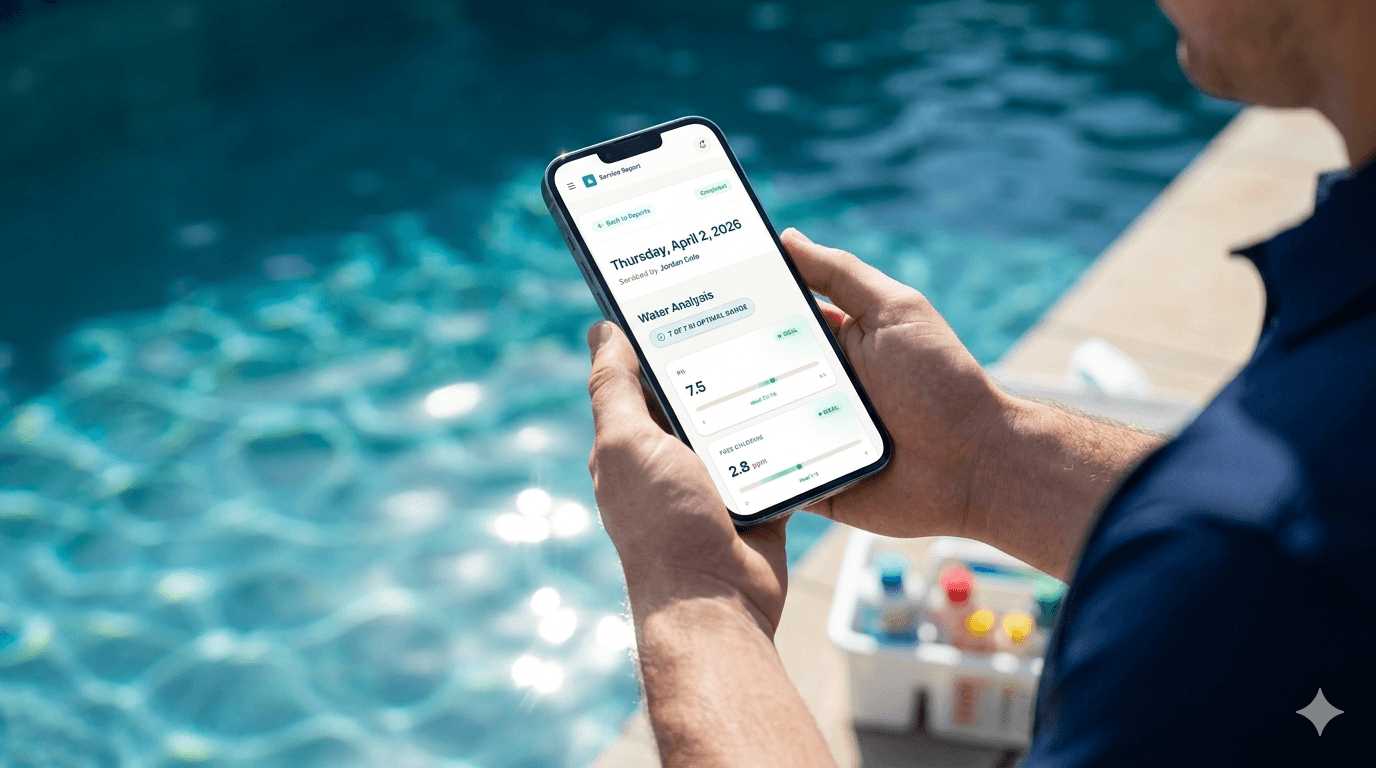
After every Clearwater service visit, you receive a digital report with water chemistry readings, work performed, and photos from the visit. Most customers glance at it and move on — which is fine. But knowing what you're looking at makes you a better-informed pool owner, and sometimes an out-of-range number is worth a closer look.
The Chemistry Readings
The top section of your report shows six key water chemistry values measured at time of service. Here's what each one means and what the ideal range looks like:
- Free Chlorine (FC) — I deal: 1–3 ppm. This is the active sanitizer in your water. Too low and bacteria can grow. Too high and it can irritate eyes and skin.
- pH — Ideal: 7.4–7.6. pH affects how effective chlorine is and how comfortable the water feels. Low pH (acidic water) corrodes equipment. High pH makes chlorine less effective.
- Total Alkalinity (TA) — Ideal: 80–120 ppm. Alkalinity buffers pH from swinging dramatically. It's the stabilizer behind the stabilizer.
- Calcium Hardness (CH) — Ideal: 200–400 ppm. Too low and water becomes aggressively corrosive to plaster and equipment. Too high and scale builds up on surfaces and in pipes.
- Cyanuric Acid (CYA) — Ideal: 30–50 ppm. CYA protects chlorine from being burned off by UV sunlight. Without it, outdoor pools consume chlorine extremely fast.
- Total Dissolved Solids (TDS) — Ideal: Under 1,500 ppm above fill water. High TDS means the water is getting "used up" and eventually needs a partial drain and refill.
What "Out of Range" Actually Means
If a value is flagged in your report, your technician has already noted it and taken corrective action when possible. A single reading outside the ideal range rarely means anything urgent. Chemistry fluctuates — bather load, rain, and temperature all affect it between visits. What you're looking for is a pattern: the same value consistently at the edge of the range visit after visit.
The Photos
Your report includes before and after photos from the visit — typically a wide shot of the pool and a close-up of the skimmer basket. These photos aren't just proof of service. They give you a visual baseline. If the water looks noticeably different from the prior visit, that's context the chemistry alone doesn't provide.
The Equipment Notes
The bottom section of your report includes any equipment observations your technician made during the visit. This is the section most worth reading carefully. Notes like "pump basket 80% full" or "small air leak at pump lid" are early warnings. Catching equipment issues before they become failures is the single biggest maintenance value we can provide.